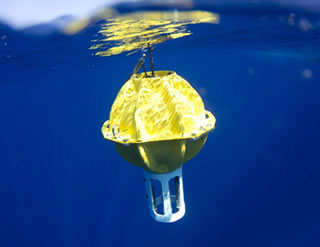
Comprehensive monitoring of ocean conditions is an important component in understanding oceanographic dynamics, global climate change, and ocean-atmosphere interactions. The Argo program has become one of the milestones in the revolution of ocean observation through a network of thousands of automatic profiling floats that measure temperature, salinity, and pressure from the surface to a depth of about 2000 meters (Riser et al., 2016). Data from Argo has improved our understanding of ocean variability, supported climate models, and improved the accuracy of long-term weather and climate predictions. However, most of the deep ocean—below 2000 meters—is still under-observed, even though this layer holds about half of the global ocean volume and plays a major role in heat storage and long-term water mass circulation. To address this challenge, Deep Profiling Argo Floats were developed. These are new-generation instruments capable of diving to depths of 4000–6000 meters with high-precision sensors that can withstand extreme pressures. This technology enables data collection from previously inaccessible deep ocean regions, providing new insights into deep ocean oceanographic dynamics and strengthening our understanding of the Earth’s climate system as a whole.
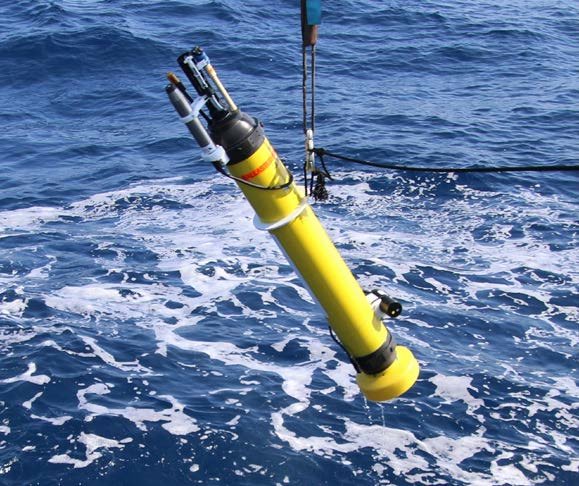
Deep Profiling Argo Floats are an advancement of conventional profiling float technology with the ability to explore much greater ocean depths, reaching 4000 to 6000 meters. This instrument consists of several main components, including a high-precision CTD (Conductivity, Temperature, Depth) sensor that is resistant to extreme pressure, a buoyancy system that can adjust its density to ascend and descend in the water column, and a satellite communication system for real-time data transmission. The CTD sensor on deep floats, such as the SBE-61 type, is specifically designed to remain accurate at high pressures, enabling it to measure temperature and salinity parameters stably in the deep sea. In addition, this instrument is equipped with a long-lasting battery system so that it can perform hundreds of profile cycles over many years. When operating, the float will “park” at a certain depth to follow ocean currents, then descend to its maximum depth to take vertical profile measurements from the seafloor to the sea surface. Once completed, the data is sent via satellite to the Argo global data center for analysis and open distribution to researchers around the world. This innovation enables continuous deep-sea observation without the need for expensive research vessels, making it an important instrument in modern oceanographic monitoring (Roemmich et al., 2019).
Deep Profiling Argo Floats is equipped with:
CTD sensor, measures conductivity, temperature, and pressure with precision at deep sea depths.
Floating system, uses an oil pump to regulate internal volume, allowing the float to rise and fall in the water column.
Body structure / pressure housing, made of borosilicate glass or strong composite material to withstand high pressure.
Satellite communication system (Iridium), transmits data to a global data center when the float is on the surface.
Power control and management system, regulates the operating cycle and battery efficiency for long operating periods.
Large-capacity battery, provides power for hundreds of profiling cycles over several years.
Additional sensors (optional). for example, dissolved oxygen, pH, or ADCP sensors for additional parameter measurements.
How Deep Profiling Argo Floats Work
Deep Profiling Argo Floats operate autonomously by following a vertical operating cycle to measure physical conditions of the ocean from the surface to depths of 4000–6000 meters. Once released into the ocean, the float will dive to a specific parking depth and passively “float” with the ocean currents for several days to record water mass movements. Next, the float descends to its programmed maximum depth, while activating its CTD sensor to continuously record vertical profiles of temperature, salinity, and pressure. Upon reaching its lowest depth, the float begins to slowly ascend to the surface with the help of an oil pump system that regulates its internal volume to change its buoyancy. During the ascent, the sensor continues to take measurements, providing highly detailed vertical data. Upon reaching the surface, the float transmits data via Iridium satellite to the global Argo data center, while also receiving configuration updates if necessary. After transmission is complete, the float dives back to its parking depth and begins the next cycle. This process can occur hundreds of times over the float’s lifespan (3–5 years), enabling continuous monitoring of deep-sea conditions without the need for research vessels.
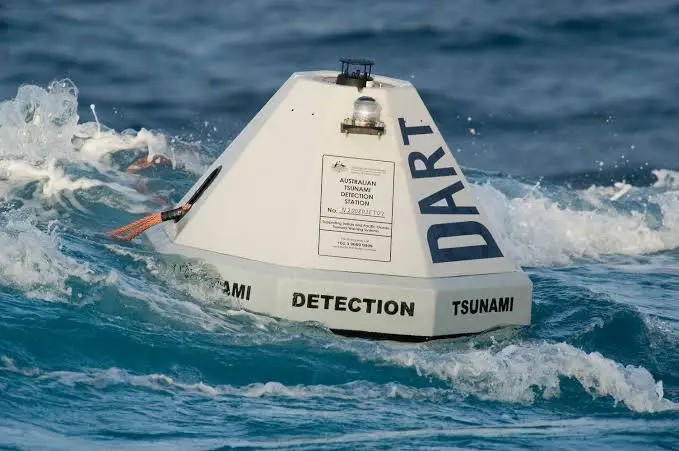
Dart Buoy strengths and weaknesses
Strengths
Strengths of Deep Profiling Argo Floats
- Capable of diving to depths of 4000–6000 meters → reaching the deep ocean layer.
- Operates autonomously and for long periods (3–5 years).
- Cost and time efficient compared to research vessels.
- Produces high-quality, globally standardized data.
- Data is transmitted in real time via satellite, enabling continuous monitoring.
- Supports climate research, physical oceanography, and ocean circulation modeling.
Weakness
Weakness of Deep Profiling Argo Floats
- High initial costs for production and deployment.
- The number of deep floats is still limited → horizontal coverage is not yet uniform.
- Difficult to repair or maintain because it operates without human intervention.
- High energy consumption when profiling to extreme depths.
- Limited to physical parameters, does not cover complex chemistry/biology.
- Spatial and temporal distribution is still less dense than standard Argo.
Writer : Muhammad Akmal Raynanda