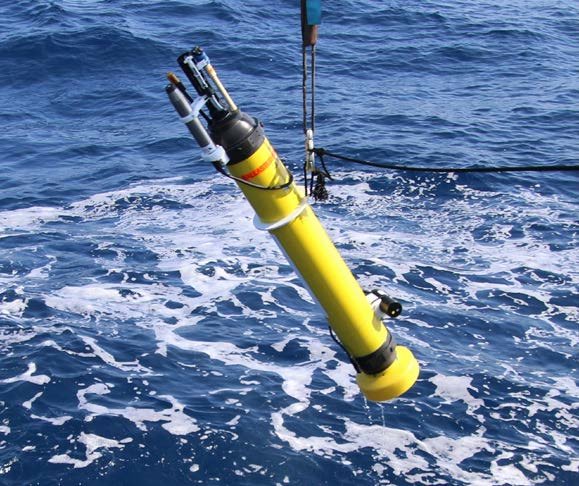
Global climate change and the complexity of ocean dynamics demand continuous, accurate, and wide-scale oceanographic monitoring. Ocean data on temperature, salinity, and currents are essential to understand air–sea interactions, biogeochemical processes, and their impacts on ecosystems and human activities. However, conventional methods such as research vessels or moored buoys are limited in both spatial and temporal coverage.
An important innovation addressing these challenges is the use of profiling floats, autonomous instruments capable of measuring vertical profiles of ocean parameters from the surface to depths of about 2,000 meters. This technology was pioneered through global initiatives such as the Argo Program, which now operates thousands of floats across the world’s oceans. By providing long-term, high-resolution datasets, profiling floats have become essential for studying climate variability, improving ocean and weather forecasts, and supporting marine resource management.
The Instrumen
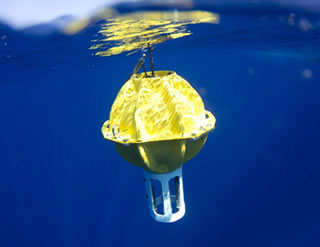
Profiling floats are autonomous underwater platforms that collect measurements in a vertical water column, such as temperature, salinity, and current movements. They use a pump to change their buoyancy in order to move up and down the column, and can be pre-programmed with depth profiles.
Many profiling floats use GPS to establish their position when at the surface, and transmit their data via satellite communications such as Iridium or Argos. They can usually make a few hundred dives to depths of several thousand metres, and are often treated as disposable.
Main Component
- Antenna (Satellite Transmitter/Receiver)
The antenna functions as the link between the profiling float and the control center on land. When the float surfaces, the antenna transmits measurement data to communication satellites such as Argos or Iridium and can also receive instructions to adjust measurement settings, such as cycle intervals or target depths. - CPU (Central Processing Unit)
The CPU acts as the brain of the profiling float. It controls the entire system, including dive and ascent cycles, as well as the operation of sensors. The CPU also stores data temporarily before transmission to the satellite, ensuring that all components work in coordination. - CTD Sensor (Conductivity, Temperature, Depth)
The CTD sensor is the primary instrument for measuring ocean parameters. Conductivity sensors calculate salinity, temperature sensors record seawater temperature, and pressure sensors determine depth. These data are vital for studying ocean circulation, water mass distribution, and climate change. - Oil Bladder (External Oil Reservoir)
The oil bladder controls buoyancy. Pumping oil outward increases the float’s volume and decreases its density, allowing it to rise. Pulling the oil back in reduces volume and increases density, causing the float to sink. This system enables vertical movement without mechanical propulsion, saving energy. - Hydraulic Pump
The hydraulic pump moves oil in and out of the oil bladder according to CPU commands. With this mechanism, the float can ascend or descend gradually through the water column, reaching depths of thousands of meters. - Battery
The battery, usually high-capacity lithium, powers the entire system, including the CPU, CTD sensors, pump, and satellite communication. The float’s operational lifespan—typically 4–5 years—depends largely on battery capacity and efficiency. - Hull (Pressure Housing)
The hull is the outer structure that protects internal components from deep-sea pressure and corrosion. It is typically made of titanium or composite plastics, providing durability, stability, and reliable function in extreme marine conditions. - Ballast Weight
The ballast weight provides balance and stability. It helps the float maintain an upright position in the water and improves efficiency during sinking and surfacing, reducing the risk of tilting or losing orientation.
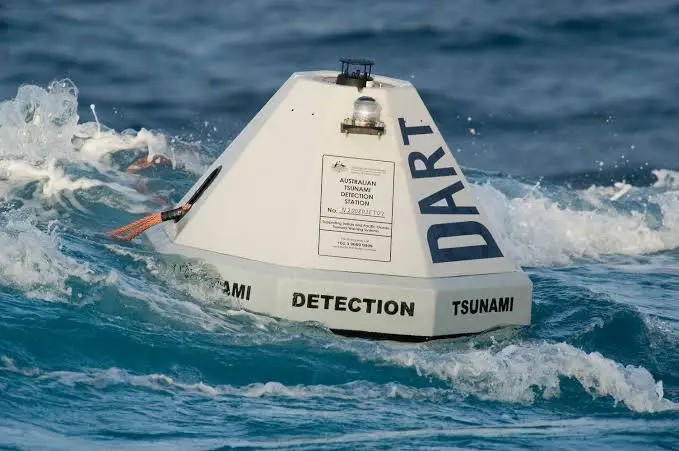
How Dart Buoy Work
The floats move up and down in the water column using a buoyancy pump, but unlike a Slocum glider, they lack wings to provide lift and forward momentum. They therefore passively drift with the ocean currents and cannot be accurately navigated. Profiling floats have very long endurances, typically remaining at sea for 3-5 years at a time.
Profiling floats are equipped with oceanographic sensors, a GPS receiver, and an Iridium satellite modem, and they return to the surface on a regular schedule (e.g., every 10 days) to transmit recently collected data to shore. We have integrated the DMON instrument in the MRV Alto float, and can transmit to shore information about marine mammal detections, ocean noise, and even marine meteorology derived from passive acoustics (wind speed and precipitation rate).
Dart Buoy strengths and weaknesses
Strengths
- Cover wide areas of the ocean, including remote regions.
- Collect detailed vertical profiles of temperature, salinity, and depth.
- Cost-effective compared to ship surveys.
- Provide continuous, long-term, and real-time data.
- Support global collaboration through shared datasets.
Weakness
- Limited to about 2,000 m depth (standard floats).
- Usually measure only basic parameters (T, S, pressure).
- Battery life is limited (about 4–5 years).
- Vulnerable at the surface (waves, ice, or ship traffic).
- Less effective in shallow or ice-covered regions.
Writer : Mikail Ahsan Prahaska